Why we test
Catch regressions early instead of in production; quantify correctness with fast feedback.
Build confidence to refactor (tests become safety net); document expected behavior via examples.
Separate concerns: cheap unit tests on logic, heavier functional tests on flows.
Today: gtest for C++, pytest for Python, plus small-data strategies and TDD loops.
Online resources
gtest primer: https://
gtest advanced: https://
pytest docs: https://
TDD intro: https://
Test taxonomy
| Type | Scope | Purpose | Example |
|---|---|---|---|
| Unit | Single function/class; no I/O | Pin down logic; fast feedback. | daily_returns on 3 prices. |
| Integration | A few modules together | Check contracts between parts. | CSV loader + stats pipeline. |
| Functional/E2E | Realistic user flow | Validate business outcome. | CLI generates vwce_gnuplot.dat. |
| Smoke/Regression | Minimal run / bug guard | Ensure binary runs; prevent recurrence. | Run main on sample CSV. |
Qualities of good tests
Deterministic: no randomness/time/network; seed data; fixed tolerances.
Isolated: no shared state; use temp dirs/files; clean up outputs.
Small and focused: one behavior per test; descriptive names.
Assertions that explain: prefer
EXPECT_NEAR,EXPECT_THROW,assert dd == pytest.approx(...).Fast: keep <100 ms per unit test; functional tests still bounded.
gtest essentials (C++)
#include <gtest/gtest.h>

TEST(Stats, DailyReturns)
{
  std::vector<PricePoint> prices = {{.close = 100}, {.close = 110}};
  auto r = daily_returns(prices);
  EXPECT_EQ(r.size(), 1);
  EXPECT_NEAR(r[0], 0.1, 1e-12);
}

int main(int argc, char **argv)
{
  ::testing::InitGoogleTest(&argc, argv);
  return RUN_ALL_TESTS();
}
Compile/link:
g++ -std=c++17 -Iinclude test.cpp -lgtest -lgtest_main -pthread.Use
EXPECT_*for non-fatal checks,ASSERT_*when later lines depend on the result.
gtest fixtures and parameters
TEST_F(FixtureName, Case)to share setup/teardown; put common data inSetUp()/TearDown().TEST_P+INSTANTIATE_TEST_SUITE_Pfor table-driven cases without copy/paste.Combine with custom matchers or
EXPECT_THAT(gmock) for readable assertions.Keep fixtures lean: prefer helper functions that return ready-to-test vectors.
pytest essentials (Python)
Discovery: files named
test_*.pyor*_test.py, functions/classes namedTest*.Plain
assertis rewritten with helpful diffs; usepytest.approxfor floats.CLI:
pytest -q,pytest tests/test_stats.py -k returns,pytest -xto stop on first failure.Parametrize cases:
@pytest.mark.parametrize("prices, expected", [...]).
pytest fixtures and helpers
Built-ins:
tmp_pathfor temp files/dirs,capfd/capsysfor stdout/stderr capture.Custom fixtures share setup: put in
conftest.py; yield resources to auto-clean.Markers:
@pytest.mark.slow,@pytest.mark.xfailfor known issues.Monkeypatching:
monkeypatch.setenv,monkeypatch.setattrto isolate from the environment.
Edge cases for the VWCE examples
Empty or 1-row CSV → loader errors or zero returns; ensure graceful handling.
Constant closes → zero variance/volatility; no division by zero.
Known mini-series → expected annualized return and drawdown dates.
Bad paths/permissions → throw/exit cleanly and emit helpful messages.
Output file contents → first/last line structure, monotone running peak.
Red–green–refactor loop
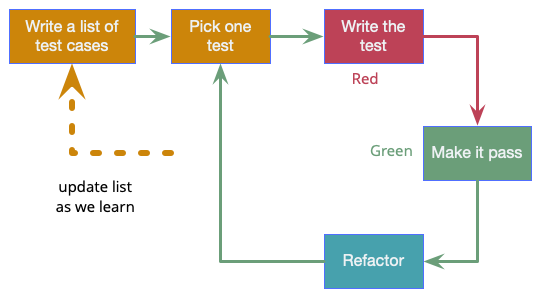
Red: write a failing test that expresses intent; run to see it fail.
Green: implement the smallest change to pass; no heroic refactors yet.
Refactor: clean code/tests with safety net; keep tests green after each small step.
Commit in small increments; keep CI scripts (
ctest,pytest) easy to run.
Running tests and structure
Suggested layout:
c++/{src,tests}withCMakeLists.txt+add_executable(tests ...);python/withtests/andconftest.py.C++ one-shot build:
g++ -std=c++17 main.cpp tests/test_vwce.cpp -lgtest -lgtest_main -pthread -o test_vwce && ./test_vwce
Python:
pytest -q python/tests(add-vvfor verbose).Make tests hermetic: bundle tiny CSV fixtures in the repo; avoid using the full 2024 dataset unless needed.
Lab 06 outline
Use the VWCE C++ and Python examples into
<name.surname>/in yoursspa-sandbox.Add gtest-based unit tests for the C++ functions (loader, returns, variance, drawdown) and a smoke test for the CLI.
Add pytest suites for the Python functions and CLI, using fixtures for sample CSVs and temp output paths.
Run tests in the provided container/toolchain; fix any bugs uncovered; keep a short lab log and push a clean branch for review.